
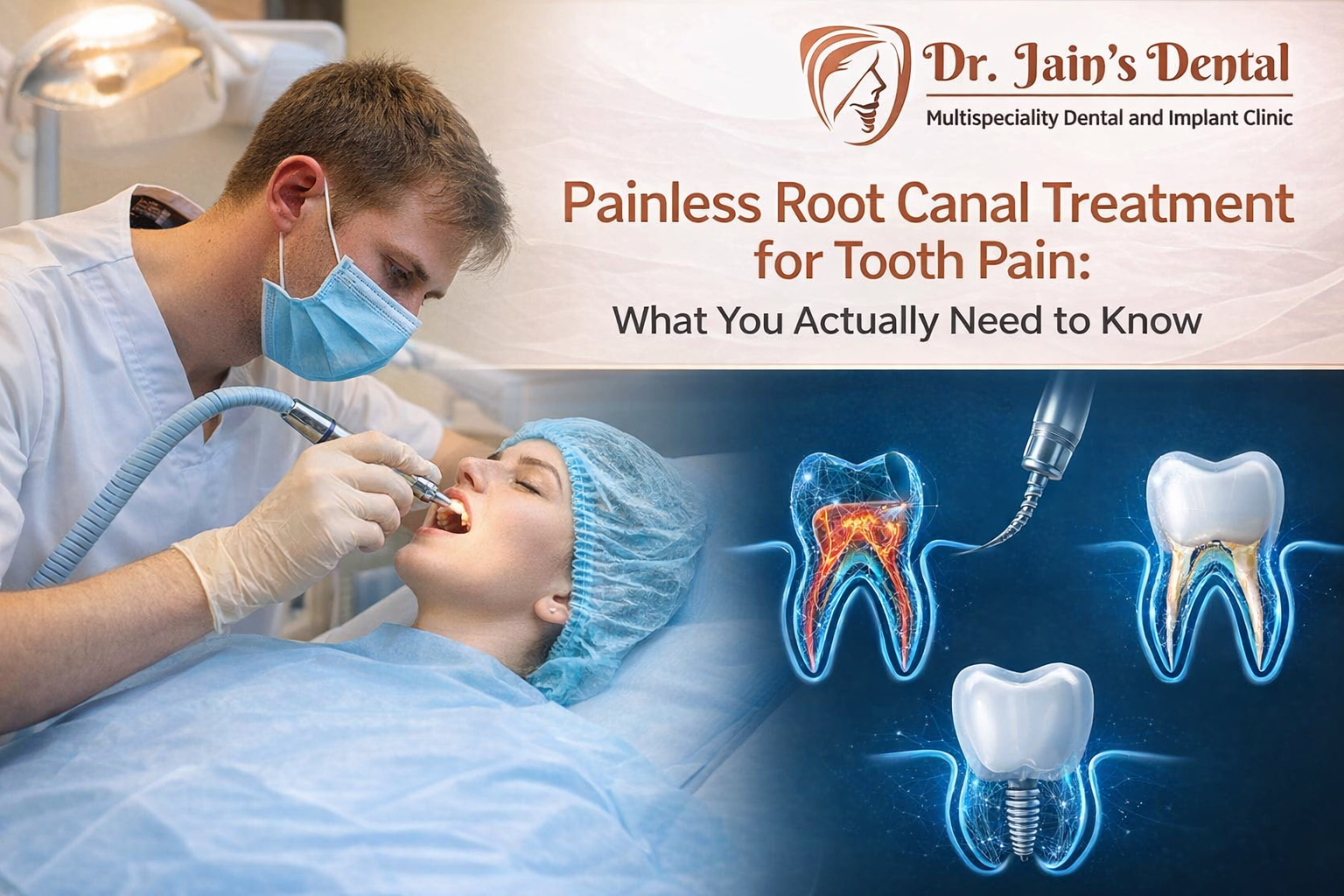
I am going to guess what is happening with you right now.
There is a tooth in your mouth that will not stop hurting. Maybe it is a sharp stab when you bite down on something. Maybe it is this dull heavy ache that just sits there all day long like a bad roommate. Maybe it waits until you lie down at night and then really gets going.
You have tried ignoring it. Does not work.
You have tried painkillers. They help for a few hours and then wear off.
You have tried chewing on the other side. Your tooth does not care.
So now you are here. Reading about root canals. And if you are honest with yourself, you are probably nervous. Because everyone has a story. Your coworker had one in 1998 and he still brings it up. Your aunt said it was the worst thing she ever went through.
I get it. Those stories stick with you.
But here is the thing. Dentistry has changed a lot since 1998. Since 2008 even. The way we numb you, the tools we use, the whole experience. It is not what it used to be.
I am going to walk you through exactly how this works. No big dental words. No trying to impress you. Just real talk from someone who has done this thousands of times.
At Dr Jain's Dental, we have been taking care of people in Noida for over twenty two years. We have seen every kind of tooth pain you can imagine. And we have fixed almost all of it.
What Is Really Going On Inside Your Tooth
Let me explain what is happening in there.
Deep inside every tooth there is a small space. Dentists call it the pulp chamber. Inside that space there are nerves and tiny blood vessels. When you were a kid, that stuff helped your tooth grow. Once you are an adult, the tooth does not really need it anymore. But it is still there.
Problems start when bacteria find their way in.
How do bacteria get in there? Lots of ways. A cavity that got too deep. A tiny crack in your tooth that you cannot even see. An old filling that started leaking. Sometimes even a hit to the mouth that damaged the nerve even though the tooth looked fine.
Once bacteria get inside that little space, they cannot get out. They are trapped in there. So they multiply. They cause infection. They cause inflammation. The nerves get squeezed because there is no room to swell up. That squeezing is what causes the pain. Sometimes it is a dull ache. Sometimes it is so sharp you cannot think straight.
A root canal is just cleaning that space out. Taking out the infected stuff. Cleaning it really well. Sealing it up so nothing can get back in. That is all it is.
The pain you have right now is from the infection. Not from the treatment. The treatment removes the infection. So the pain goes away.
Let Me Tell You About the Painless Part
I know this is the part everyone cares about.
So here is the honest truth. The procedure itself should not hurt. Not if it is done right.
Before we do anything, we numb you really well. Not just a little. We use a gel first so you do not even feel the needle going in. Then we give the numbing medicine slowly. Within a few minutes, your tooth, your gum, everything around it goes completely numb.
During the procedure, you might feel pressure. You might feel vibration from the tools. But sharp pain? No. That should not happen.
And here is the important part. If you feel something uncomfortable at any point, you raise your hand. We stop immediately. We add more numbing. We wait. We do not keep going until you are comfortable.
At Dr Jain's Dental, Prof. Dr. Harsh Jain has been doing this for twenty two years. He knows exactly how much numbing to use. He knows exactly how to move so you stay comfortable. That is why people come to him. That is why people send their families to him.
The stories you heard about root canals hurting? Those are old stories. From decades ago before modern numbing existed. That is not how it works anymore.
How You Know You Might Need One
Not every toothache needs a root canal. But some do. Here is how you can tell.
The Pain Never Really Stops
If your tooth hurts all the time, or if the pain comes and goes but never fully leaves, that is a sign. Especially if it wakes you up at night. Pain when you lie down usually means the nerve is angry.
Hot and Cold Hang Around Too Long
If you drink coffee and your tooth hurts for minutes after, that is not normal. Regular sensitivity fades in seconds. If it lingers, something is wrong inside.
You Notice a Bump on Your Gum
Sometimes a little pimple shows up on the gum near the sore tooth. It might drain a little fluid. That is infection trying to escape. The tooth underneath is almost certainly dead or dying.
The Tooth Looks Different
If a tooth turns gray or dark, the nerve inside is probably dead. You might not feel pain with this one. But the infection is still there. It will cause problems eventually.
Biting Down Hurts
If you touch the tooth or bite on something and pain shoots through, the nerve is irritated.
Nothing Hurts at All
This one tricks people sometimes. The nerve can die quietly. No pain at all. But the infection keeps spreading into the bone. That is why regular checkups matter. X-rays catch things you cannot feel.
What Actually Happens Step by Step
Let me walk you through a root canal so you know exactly what to expect. No surprises.
The Numbing Part
We start with a gel on your gum. It tastes a little funny but it numbs the surface. Then we give the injection. You might feel a tiny pinch or just some pressure. Then we wait a few minutes. We test the tooth to make sure you cannot feel anything. Then we start.
The Isolation Part
We put a small rubber sheet around your tooth. It keeps the tooth dry and clean. It also stops anything from falling in the back of your throat. You can still breathe fine. You can still swallow fine.
The Opening Part
Dr. Jain makes a tiny hole in the top of your tooth. This is how we get inside. You will feel vibration but not pain.
The Cleaning Part
This takes the longest. He uses tiny instruments to remove the infected nerve and clean out the space inside the roots. Roots are small and curved so this takes time. We want every bit of infection gone.
The Washing Part
We flush the inside of the tooth with special liquids that kill any remaining bacteria. This helps make sure nothing is left behind.
The Sealing Part
Once the tooth is clean and dry, we fill the empty space with a material that seals it. This keeps bacteria from getting back in.
The Temporary Part
We put a temporary filling on top. This protects the tooth while you heal.
The Crown Part
Later, usually after a week or two, you come back for a permanent crown. The crown covers the whole tooth and keeps it from breaking. Teeth that have root canals can get brittle over time. The crown holds them together.
Quick Look at the Process
|
Step |
What Happens |
How Long It Takes |
|
Numbing |
Gel and injection |
About 5 to 10 minutes |
|
Opening |
Small hole in tooth |
A few minutes |
|
Cleaning |
Removing infection |
30 minutes to an hour |
|
Washing |
Flushing with medicine |
A few minutes |
|
Sealing |
Filling the space |
About 15 minutes |
|
Temporary |
Placing temporary filling |
A few minutes |
|
Crown |
Permanent cover |
Second visit |
Why People Come to Dr Jain's Dental
When you search for "painless root canal treatment for tooth pain" , you see a lot of names. So why us?
Prof. Dr. Harsh Jain is not a general dentist who does a little bit of everything. He is a maxillofacial surgeon. That means after dental school, he spent years more training in surgery and complex cases. He holds a gold medal. He has over twenty two years of experience.
But more important than all of that, he actually listens. He knows people are scared. He knows you might have been putting this off for months or years. He moves at your speed. He explains things before he does them. He checks on you during the procedure.
At Dr Jain's Dental, we are not trying to rush you in and out. We are trying to fix your tooth and send you home comfortable.
Questions Real Patients Ask
Here are the things people actually ask when they come to see us. Not the stuff you find on random websites. Real questions from real people who were sitting where you are sitting now.
1. Will I feel anything during the procedure?
No. You will be completely numb. You might feel pressure or vibration but not sharp pain. And if you feel something, we fix it right away.
2. How long will I be in the chair?
For a regular tooth, about an hour to an hour and a half. Back teeth with multiple roots take longer than front teeth.
3. Do I have to come back more than once?
Usually two times. One for the root canal. One for the crown. Sometimes if the infection is bad, we put medicine inside and have you come back in a week to finish.
4. Can I eat normally after?
Yes, after the numbness wears off. But stick to soft foods on that side until the crown is on. The tooth is protected but not fully strong yet.
5. Why not just pull the tooth out?
Pulling is faster. But then you have a missing tooth. Missing teeth cause other teeth to shift. Then you need an implant or bridge to fill the space. That costs more and takes longer. Saving your tooth is usually the better choice.
6. How long will this tooth last after treatment?
If you take care of it and get the crown, it can last decades. Maybe your whole life. Brush, floss, and see us regularly.
7. Why do I need that crown exactly?
The tooth becomes weaker after a root canal. Without a crown, it can crack when you chew. The crown protects it and holds it together.
8. Can the infection come back later?
It is rare if the root canal was done well. But it can happen. If it does, we can do the procedure again or send you to a specialist.
9. How much is this going to cost me?
It depends on the tooth. Front teeth cost less because they are easier. Back teeth cost more because they have more roots. Come in and we will tell you exactly what your tooth needs and what it costs.
10. How do I know for sure if I really need one?
You stop guessing and come see us. We look at the tooth. We take an x-ray. We tell you what is going on. No pressure. Just answers.
What Happens When You Walk In
You walk into Dr Jain's Dental with a tooth that hurts. Maybe you are nervous. Maybe you have been avoiding this for a while.
First thing. We do not make you wait. Tooth pain is an emergency. We get you in.
You sit down. You tell us what is going on. When it started. What makes it worse. What makes it better.
Then we look. We check the tooth. We check the gums around it.
Then we take an x-ray. This shows us what is happening inside. It shows us if the infection has spread to the bone. It shows us exactly what we are dealing with.
Then we talk. Dr. Jain explains what he sees. If you need a root canal, he tells you why. He explains the whole thing. He answers every question you have.
If you want to move forward, we schedule it. If you need time to think, take time. No pressure at all.
Other Words You Might Hear
If you are reading up on this, you might come across these words. They all relate to what we do at Dr Jain's Dental.
root canal therapy, infected tooth, dental abscess, endodontic treatment, save your tooth, tooth infection, dental pain relief, RCT dentist, root canal specialist, dental crown, tooth extraction alternative, pulpitis, nerve pain, emergency dentist Noida, infected root canal, tooth preservation, dental clinic near me, painless dentistry.
One Last Thing
Tooth pain is the worst. It wears you down. It makes everything harder. Eating, sleeping, working, being around people. It takes over your whole life.
But here is the good news. It is fixable. And fixing it does not have to be some horrible experience that you dread for years.
Modern painless root canal treatment for tooth pain is routine. Millions of people get it every year. They go back to work the next day. They eat normally again. They sleep through the night.
At Dr Jain's Dental, we have been doing this for over twenty two years. We know how to make it easy. We know how to make it comfortable.
If your tooth is hurting, do not wait. Infections do not get better by themselves. They get worse. They spread. They become harder to fix.
Come see us. Bring your tooth. Bring your questions. Bring your fear if you have it. We will take care of the rest.
No judgment. Just help.