
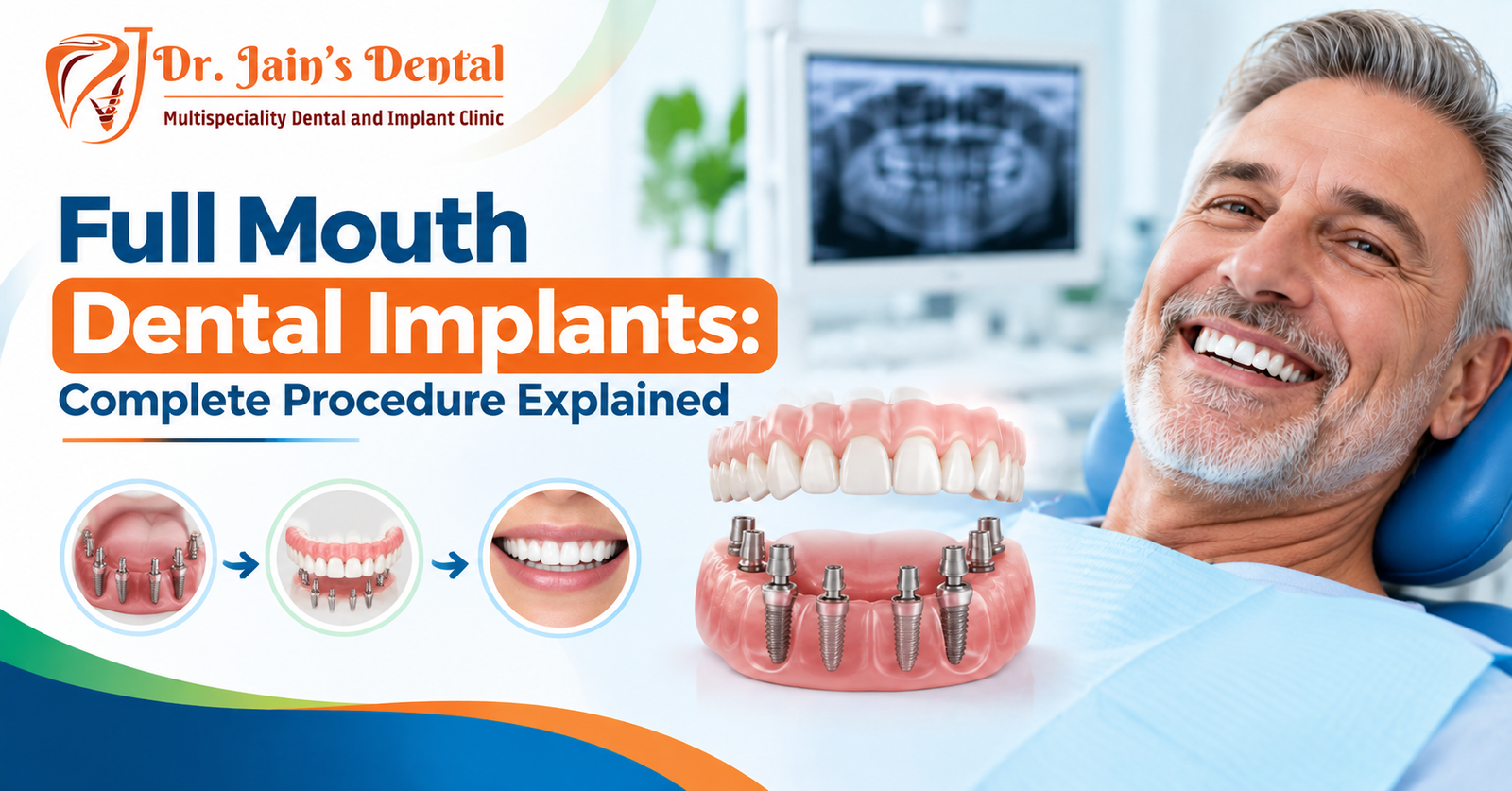
Losing several teeth changes more than a smile. It changes how you chew, speak, and sometimes even how confidently you sit across a dinner table. Dentures can help, but they may move while eating or feel unfamiliar in the mouth. Full mouth dental implants take a different route: instead of simply replacing the visible teeth, they use implants placed into the jawbone to support a fixed set of replacement teeth.
That sounds like a major procedure. And, frankly, it is. But it isn't one giant dental appointment where you walk in with missing teeth and walk out with a finished smile.
There are stages.
The First Step: A Detailed Dental Assessment
Everything begins with an examination at Dr Jain's Dental & Implant Clinic. The dentist looks at the condition of your gums, remaining teeth, jawbone, bite, and overall oral health. Digital imaging and scans may be used to understand the bone structure and determine where implants can be placed safely.
Why so much planning?
Because an implant isn't something a dentist simply "fits" into an empty space. The implant needs suitable bone support, the right position, and enough stability to eventually hold a replacement tooth. In some patients, bone grafting or other preparatory treatment may be necessary before implant placement.
Dental Implants and Diabetes: Can They Be Done?
This is one of those myths that refuses to disappear: people with diabetes often assume dental implants are simply off the table.
Not necessarily.
Patients with well-controlled diabetes can often undergo dental implant treatment safely. When blood sugar is properly managed and HbA1c levels are within the range considered suitable by the treating dentist and surgeon—often around 6.5–7% or below—implant treatment may be possible without significantly compromising healing.
But here's the thing: diabetes isn't something to ignore during implant planning. Poorly controlled blood sugar can affect healing and increase the risk of complications, which is why your dentist may review your recent HbA1c results and overall medical history before proceeding.
So don't let the diagnosis alone make the decision for you.
Let the numbers. Let the examination. Let the surgeon's assessment.
Choosing your dentist or implant surgeon wisely matters, particularly when an existing medical condition needs to be considered alongside the dental treatment. With appropriate planning, blood-sugar control, surgical care, and follow-up, many diabetic patients can successfully receive dental implants.
Keep smiling.
Treatment Planning Comes Before Surgery
Once the assessment is complete, a personalised treatment plan is created. This is where the number and position of implants, the type of replacement teeth, and the sequence of procedures are decided.
Full-mouth treatment doesn't necessarily mean placing one implant for every missing tooth. Depending on the patient's condition, implant design and treatment approach, several strategically positioned implants can support a full arch of replacement teeth.
This is also the stage where practical questions get answered—how long the treatment may take, what temporary teeth might be used, and what the expected recovery period looks like.
No guesswork.
Implant Placement
The next stage is implant surgery.
Small titanium implant fixtures are placed into the jawbone at carefully planned positions. These fixtures act as artificial tooth roots. The procedure is performed under appropriate anaesthesia, with the exact surgical approach depending on the patient's needs.
After placement, the jawbone needs time to integrate with the implants. This biological process, known as osseointegration, is what gives the implants their long-term stability.
And this is where patience matters.
Your new teeth may look impressive early on, but the underlying foundation still needs time to heal properly.
Temporary Teeth and Healing
Depending on the treatment plan, temporary teeth may be provided during the healing phase. They allow patients to maintain everyday function and appearance while the implants integrate with the bone.
The healing period varies. There isn't a universal stopwatch because bone quality, blood-sugar control, general oral condition, the number of implants, and the complexity of the procedure can all influence recovery.
Fitting the Permanent Teeth
Once the implants have healed sufficiently and the dentist confirms that they are stable, the permanent restoration is prepared.
Measurements, bite relationships, tooth shape, colour, and overall smile appearance are considered. The replacement teeth are then securely attached to the implants.
This is the part patients usually imagine first—the finished smile—but it only works because the less glamorous stages happened beforehand.
Aftercare Is Part of the Treatment
Implants aren't maintenance-free. They still need regular cleaning, professional check-ups, and sensible oral hygiene. Patients with diabetes should also keep their blood sugar well controlled and follow their dentist's instructions carefully.
For patients considering Full Mouth Implant Treatment in Noida, choosing a clinic that focuses on careful diagnosis, surgical planning, restoration, and follow-up can make the process far easier to navigate.
At Dr Jain's Dental & Implant Clinic, the emphasis is on planning the treatment around the individual patient rather than treating every full-mouth case as though it were identical.
Because every mouth tells a different story.
And the best implant treatment begins by listening to it.