
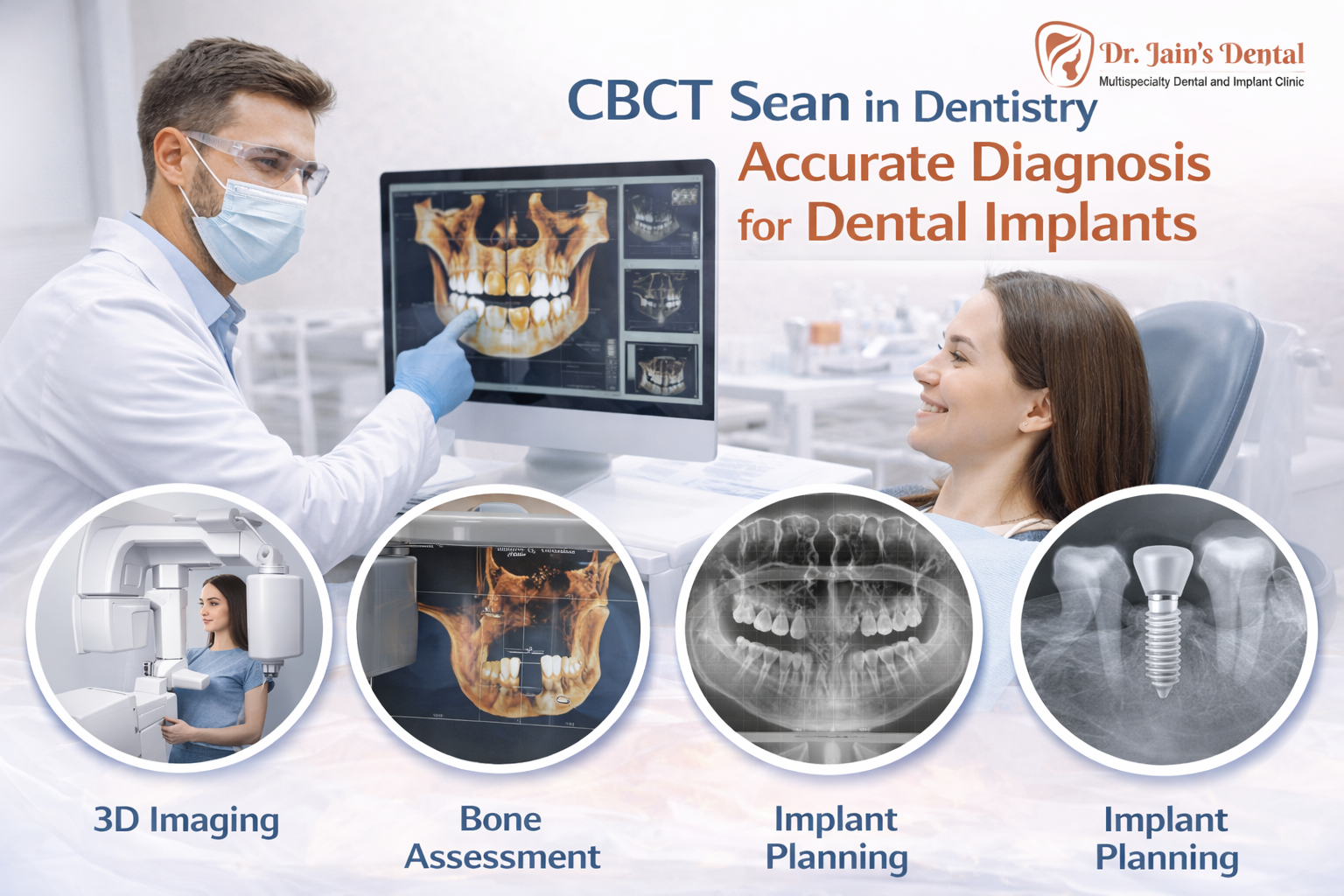
You are sitting in the dental chair. You have been told you need an implant or maybe a root canal. The dentist says something about taking a CBCT scan. You nod along, but inside you are wondering what that even means and why you need it.
I am Prof. Dr. Harsh Jain from Dr Jain's Dental. I have been doing oral and maxillofacial surgery in Noida for over twenty-two years. Dr. Roli Jain is our endodontist who does root canals every day. Together, we use CBCT scans regularly to make sure we get things right the first time.
Let me explain what CBCT is, why it matters for your treatment, and how it helps us give you the best possible care.
What Is a CBCT Scan?
CBCT stands for Cone Beam Computed Tomography. That is a mouthful, so let me put it simply.
Think of a regular dental x-ray like a photograph of your tooth. It is flat. You see the front, but you cannot see what is happening behind or inside.
A CBCT scan is completely different. It creates a three-dimensional image of your teeth, your jawbone, your nerves, and everything else in your mouth. It is like having a 3D model that we can rotate, zoom into, and examine from every angle .
The machine rotates around your head for about ten to forty seconds, capturing hundreds of images. Those images are then combined by a computer to create one detailed 3D picture .
This technology has completely changed how we plan dental treatments. Before CBCT, we were working with limited information. Now we see everything clearly before we even start .
Why CBCT Is Essential for Dental Implants
Dental implants are the closest thing to natural teeth. A small titanium post goes into your jawbone, and after healing, a crown is attached on top. It looks and functions like a real tooth.
But placing an implant is not simple. The jawbone contains nerves, blood vessels, and sinuses. If an implant is placed too close to a nerve, it can cause numbness. If it goes into a sinus, it can cause problems .
This is where CBCT becomes absolutely essential.
Before CBCT, dentists placed implants using two-dimensional x-rays. They could see height but not width. They could not see the exact path of nerves. There was a lot of guesswork involved .
Now, with CBCT, we know exactly what we are working with. We can measure bone density. We can see the exact location of nerves. We can plan the perfect position for your implant before we ever pick up a surgical instrument .
Research shows that using CBCT for implant planning leads to higher success rates and fewer complications . It is not just a nice extra. For complex cases, it is the standard of care.
What a CBCT Scan Shows Before Implant Surgery
Let me walk you through what we actually see on a CBCT scan.
Bone quality and quantity. Not all bone is the same. Some is dense and strong. Some is softer. The scan shows us exactly how much bone you have and how dense it is . This tells us whether an implant is possible or if you might need a bone graft first.
Nerve location. The lower jaw has a nerve called the inferior alveolar nerve. If an implant touches it, you could have permanent numbness in your lip and chin . CBCT shows us exactly where that nerve runs so we can avoid it completely.
Sinus position. The upper jaw has sinuses above the back teeth. Sometimes these sinuses drop down and leave little room for implants . The scan shows us exactly how much space we have and whether we need to lift the sinus to create room.
Adjacent teeth roots. Implants need to be placed between existing teeth. The scan shows the roots of those teeth so we can position the implant perfectly in the space available.
With all this information, we create a surgical plan. Sometimes we even make a surgical guide, a custom template that fits over your teeth and shows us exactly where to place the implant .
How CBCT Helps with Root Canal Treatment
Our focus keyword for this blog is "Comprehensive Root Canal Therapy for Pain Relief." CBCT plays a huge role in making that happen.
Root canals are all about cleaning out infection from inside your tooth. But teeth are not simple. They have curves, branches, and sometimes extra canals that are not visible on regular x-rays .
A 2024 study published in the Journal of Pharmacy and Bioallied Sciences explained that CBCT provides detailed 3D images that help endodontists visualize intricate root canal anatomy, detect additional canals, and locate periapical lesions that might be missed on traditional x-rays .
Here is what CBCT reveals for root canal treatment:
Extra canals. Many teeth, especially molars, have canals that are hard to see. The upper molars often have a second canal in the front root called MB2. If we miss it, the infection remains and the tooth keeps hurting. CBCT shows us every canal so we can clean them all .
Complex anatomy. Some roots are curved in ways that do not show on 2D x-rays. Others have unusual shapes. Seeing this beforehand means we can plan our approach and avoid breaking instruments inside the tooth .
Hidden infections. Sometimes infection is present but not visible on regular x-rays. CBCT catches these early, allowing us to treat them before they become bigger problems .
Cracked teeth. Vertical cracks in roots are hard to diagnose but often cause pain. CBCT helps us see these cracks and decide whether the tooth can be saved or needs extraction .
A 2025 continuing education course on endodontics emphasized that 3D imaging with CBCT supports accurate diagnosis, helps with treatment planning, and improves outcomes for complex root canal cases .
When you come to Dr Jain's Dental for comprehensive root canal therapy for pain relief, we use CBCT to make sure we find and treat every part of the infection. That is how we stop your pain for good.
CBCT vs Regular X-Rays: A Simple Comparison
Let me show you the difference in plain terms.
|
Feature |
Regular Dental X-Ray |
CBCT Scan |
|
What you see |
Flat, 2D image |
3D model you can rotate |
|
Bone assessment |
Height only |
Height, width, and density |
|
Nerve location |
Guessing based on averages |
Exact path visible |
|
Hidden infections |
Often missed |
Clearly visible |
|
Extra canals |
Invisible |
Can be identified |
|
Radiation |
Very low |
Low but higher than regular x-ray |
|
Treatment planning |
Limited information |
Complete picture |
Is CBCT Safe?
This question comes up often. People worry about radiation.
Here is the truth. CBCT does use radiation, but much less than a medical CT scan. Depending on the machine and settings, CBCT exposes you to about two hundred to three hundred times less radiation than a traditional medical CT .
Modern CBCT machines have low-dose protocols. We can adjust the scan to use the smallest field of view and lowest radiation needed for your specific situation .
At Dr Jain's Dental, we follow the ALARA principle. As Low As Reasonably Achievable. We only take CBCT scans when there is a clear benefit that outweighs the small risk. For implant planning and complex root canals, that benefit is huge.
What Happens During a CBCT Scan
If you have never had one, here is what to expect.
You stand or sit comfortably. The machine rotates around your head. It takes about ten to forty seconds. You do not feel anything. There is no pain, no discomfort. You just stay still and breathe normally .
After the scan, the images are ready immediately. We can look at them together on the screen. I can show you your bone, your nerves, your sinuses. I can point to where the problem is and explain exactly what we need to do.
No waiting. No guessing. Just clear information.
How CBCT Helps with Other Dental Treatments
While implants and root canals are the main uses, CBCT helps with many other situations.
Wisdom teeth removal. When wisdom teeth are impacted, they can sit close to nerves. A CBCT scan shows the exact relationship between the tooth and the nerve . This helps us remove the tooth safely without nerve damage .
Jaw joint problems. For patients with TMJ pain, CBCT shows the bones of the joint in detail. We can see arthritis, displacement, or other issues .
Orthodontics. For complex tooth movements, CBCT shows root positions and bone thickness. This helps orthodontists plan safe tooth movement without damaging roots or bone .
Facial surgery. For patients needing jaw surgery, CBCT is essential for planning. We use it to design the surgery and predict outcomes .
Why People Trust Dr Jain's Dental for Complex Cases
When you search for the "Best Dentist In Noida," you are looking for someone who uses the best technology and has the experience to use it well.
At Dr Jain's Dental, we have invested in modern CBCT technology because it makes a real difference in patient outcomes .
Prof. Dr. Harsh Jain, that is me, has over twenty-two years of experience in oral and maxillofacial surgery. I have placed thousands of implants and performed countless complex surgeries. Dr. Roli Jain is our endodontist who does root canals every single day.
We do not just take scans. We know how to read them. We know how to use that information to plan treatment that is safe, precise, and effective .
Our clinic is equipped with everything needed for comprehensive care. From digital x-rays to CBCT to advanced surgical tools, we have invested in technology that helps us serve you better.
Frequently Asked Questions
These are real questions from patients who came to us for implants and root canals.
1. What is a CBCT scan in dentistry?
CBCT stands for Cone Beam Computed Tomography. It is a 3D x-ray that creates a detailed model of your teeth, jawbone, nerves, and sinuses. It helps dentists plan treatments more accurately .
2. Why do I need a CBCT scan for a dental implant?
Implants need to be placed precisely. The scan shows us your bone quality and quantity, the exact location of nerves, and the position of sinuses. This information helps us place the implant safely and successfully .
3. Is CBCT safe?
Yes. CBCT uses much less radiation than a medical CT scan. Modern machines have low-dose protocols, and we only use it when necessary. The benefit of accurate treatment planning far outweighs the small risk .
4. How long does a CBCT scan take?
The actual scan takes ten to forty seconds. The whole appointment, including positioning and explanation, is usually about ten to fifteen minutes .
5. Does a CBCT scan hurt?
Not at all. You just sit or stand still while the machine rotates around your head. There is no contact, no noise, no discomfort .
6. How does CBCT help with root canal treatment?
Root canals have complex anatomy with curves and extra canals. CBCT shows us all of this so we can clean every part of the infection. This leads to better outcomes and lasting pain relief .
7. Can CBCT detect infections that regular x-rays miss?
Yes. Regular x-rays are flat and can hide infections behind bone or other structures. CBCT shows everything in 3D, so hidden infections become visible .
8. Is CBCT covered by insurance?
Coverage varies by insurance plan. Some plans cover CBCT for implant planning or complex root canals. We can help you check your coverage before proceeding .
9. How often should I get a CBCT scan?
CBCT is not a routine scan like regular x-rays. It is used for specific situations like implant planning, complex root canals, or surgical procedures. Most patients only need one for their specific treatment .
10. What is the difference between CBCT and panoramic x-ray?
A panoramic x-ray is a flat 2D image of your whole mouth. It shows height but not depth. CBCT is 3D and shows height, width, and depth. It also shows cross-sections that reveal nerve positions and bone density .
11. Can CBCT be used for children?
Yes, but only when necessary. Pediatric dentists use CBCT for specific situations like impacted teeth, cleft palate evaluation, or complex orthodontic cases. We use low-dose protocols to minimize radiation .
12. Why choose Dr Jain's Dental for CBCT and implants?
Over twenty-two years of experience. Modern CBCT technology. A team that includes specialists in surgery and root canals. Transparent pricing and honest advice. That is why patients trust us .
The Bottom Line
CBCT technology has transformed how we plan dental treatments. For implants, it means safer placement and better long-term success. For root canals, it means finding every canal and treating every bit of infection.
When you come to Dr Jain's Dental for comprehensive root canal therapy for pain relief or for dental implants, you are getting the benefit of advanced technology combined with decades of experience.
If you are in Noida and searching for the Best Dentist In Noida to handle your complex dental needs, come see us. We will take a CBCT scan if needed, explain everything clearly, and create a treatment plan designed for your specific situation.
Your smile deserves the best. Let us help you get there.