
Let me paint a picture for you.
You go to the dentist because something feels off. Maybe a tooth hurts. Maybe you are thinking about getting an implant. Maybe your orthodontist said you need braces and they want to see what is really going on in there.
The dentist takes a normal x-ray. The little one where you bite down on that plastic wing thing. And they look at it and say "Hmm, we need more information."
That is where CBCT comes in.
If you have been searching for "CBCT scan near me" , you probably heard that word from your dentist. CBCT. And you might be wondering what it is, why you need it, and if it is safe.
Let me explain it like you are sitting across from me.
At Dr Jain's Dental, we have been using this technology for years. Prof. Dr. Harsh Jain and Dr. Roli Jain rely on it every single day to make sure they never have to guess about what is happening inside your mouth. Because when it comes to your teeth and your jaw, guessing is not good enough.
What Actually Is a CBCT Scan?
CBCT stands for Cone Beam Computed Tomography. That is a mouthful, I know.
Here is the simple version.
Regular dental x-rays give you a flat picture. Like taking a photo of a house from the front. You can see the door and the windows but you have no idea what the back looks like or what is inside the walls.
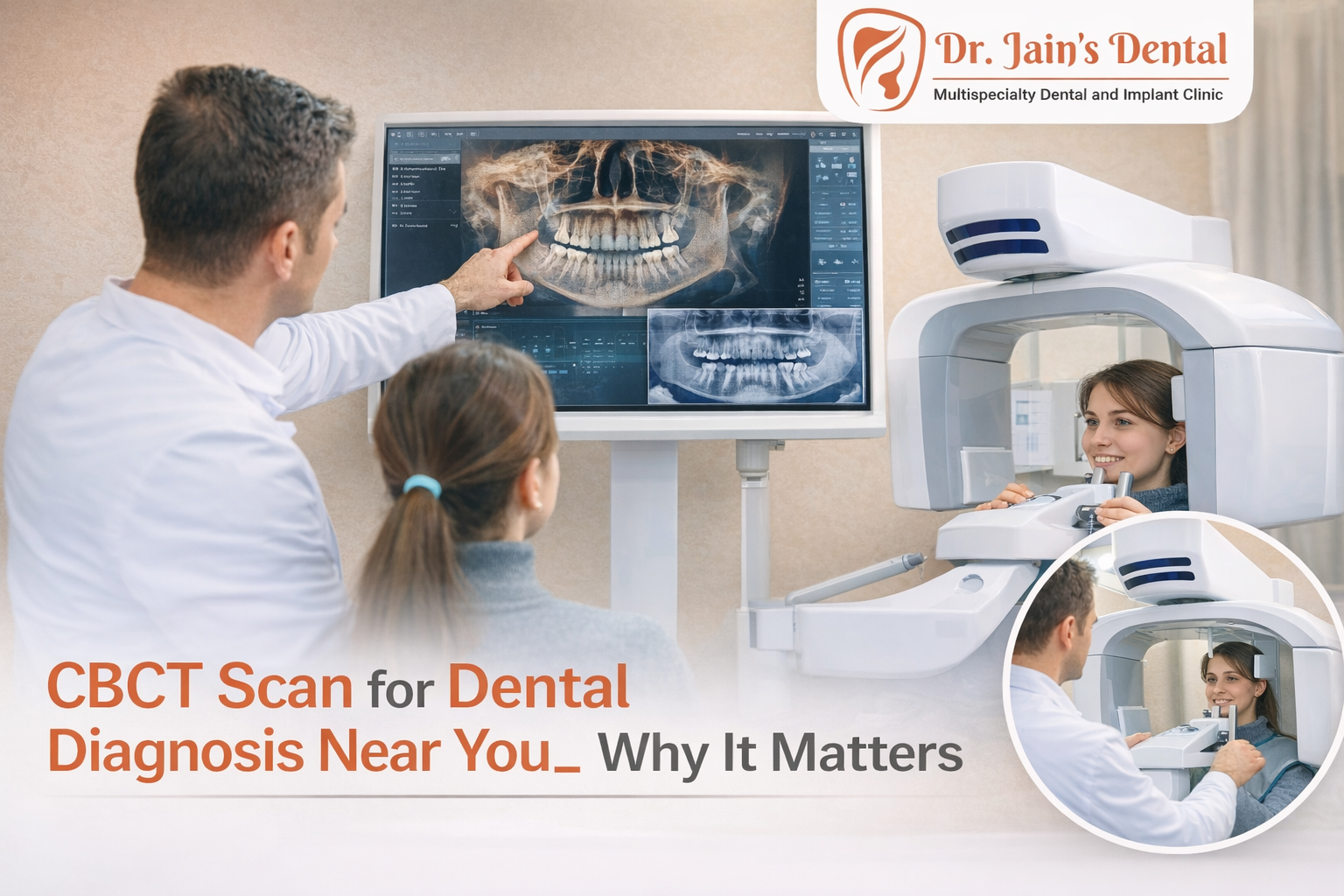
A CBCT scan is different. The machine rotates around your head and takes hundreds of images from every angle. Then a computer puts them all together to create a 3D model of your teeth, your jawbone, your nerves, everything .
It is like having a map instead of just a drawing.
This matters because your mouth is not flat. It is three dimensional. Roots curve. Nerves run in paths. Bone has thickness and density. A regular x-ray cannot show you any of that properly.
State-of-the-art CBCT scans for accurate diagnosis let your dentist see exactly what is going on . Not a guess. Not an estimate. The real thing.
How Is It Different From Regular Dental X-Rays?
This is the question people ask most often.
Regular dental x-rays have been around forever. They are good for finding cavities between teeth and checking the health of your bone at a basic level. But they have limits .
Think of it this way.
Regular x-ray is like looking at your hand in bright light. You can see the outline. You can see the big stuff.
CBCT is like having X-ray vision. You can see every bone in your hand from every angle. You can measure exactly how thick each bone is. You can see if there is a tiny crack that the light would never show you.
Here is a quick comparison :
|
Feature |
Regular Dental X-Ray |
CBCT Scan |
|
Image Type |
Flat 2D picture |
Full 3D model |
|
What You See |
Basic outline |
Every angle, every layer |
|
Measurements |
Rough estimates |
Accurate down to less than 0.1mm |
|
Best For |
Finding cavities, routine checks |
Implants, surgery, complex root canals |
|
Radiation |
Low |
Higher than regular x-ray but much lower than medical CT |
The radiation piece is important. People worry about it. CBCT does give more radiation than a regular dental x-ray. But it gives way less than a medical CT scan . And at Dr Jain's Dental, we only use it when we really need it. Not for everything. Just for the cases where that extra information changes the outcome.
When Would You Need One?
Not every dental visit needs a CBCT. But there are situations where it is the only way to do things right.
Dental Implants
If you are getting an implant, your dentist needs to know exactly where to put it. How thick is your bone? Is there enough? Where is the nerve? Where is the sinus? Guessing here can lead to big problems. CBCT gives a roadmap so the implant goes in safely the first time .
Complex Root Canals
Sometimes a tooth has roots that curve in weird ways. Sometimes there is an extra canal that regular x-rays miss. CBCT shows all of that. It helps the dentist find every bit of infection and clean it out completely .
Wisdom Teeth Removal
Wisdom teeth, especially the ones in the bottom, sit close to a major nerve. If that nerve gets damaged during removal, you could have numbness in your lip for months or forever. CBCT shows exactly how close the tooth is to that nerve. The surgeon can plan the removal to avoid it .
Impacted Teeth
Sometimes teeth get stuck in the bone and will not come out on their own. CBCT shows exactly where they are and what they are bumping into .
Jaw Pain or TMJ Issues
If you have pain in your jaw joint, CBCT can show if there is damage to the bone or if something is out of place .
Cysts or Tumors
If there is something suspicious in your jaw, CBCT gives a clear picture of how big it is and what it is affecting .
Orthodontics
For complicated braces cases, especially if surgery is involved, CBCT helps the orthodontist see exactly how teeth are positioned in the bone .
What Happens During the Scan
This part is easy. Really easy.
You walk in. You sit down or stand depending on the machine. The technologist positions your head. You hold still for maybe 20 to 40 seconds . Some scans are even faster, like under 10 seconds for a small area .
The machine rotates around your head. You might hear a humming sound. That is it.
No pain. No poking. No uncomfortable things in your mouth.
You breathe normally. You wait. It is done.
Then the computer does its work and builds the 3D model. Within minutes, your dentist has a complete picture of what is going on inside.
Why Accuracy Matters So Much
Here is the thing about dentistry.
When a dentist works on your tooth, they cannot see everything. The tooth is surrounded by gum and bone. The roots go deep. The nerves are hidden.
For decades, dentists had to rely on experience and intuition. They knew generally where things were. But generally is not always good enough.
State-of-the-art CBCT scans for accurate diagnosis change that completely .
Now, before an implant, we know exactly how much bone there is. We know exactly where the nerve runs. We can place the implant in the perfect spot so it lasts for decades.
Before a root canal, we know exactly how many roots there are and which way they curve. We do not miss canals anymore.
Before a wisdom tooth removal, we know exactly how close that tooth is to the nerve. We do not have to guess and hope.
Accuracy means safety. Accuracy means better results. Accuracy means you do not have to come back later to fix something that went wrong.
Quick Look at CBCT Uses
|
Dental Specialty |
What CBCT Helps With |
|
Implants |
Measuring bone, placing implants safely away from nerves |
|
Root Canals |
Finding hidden canals, seeing cracks, checking for infection |
|
Oral Surgery |
Planning wisdom tooth removal, avoiding nerve damage |
|
Orthodontics |
Seeing tooth position, planning for braces or surgery |
|
Periodontics |
Checking bone loss, evaluating gum disease |
|
TMJ Disorders |
Looking at the jaw joint, seeing bone changes |
|
Pathology |
Finding cysts, tumors, or other abnormalities |
Why Dr Jain's Dental Uses CBCT
At Dr Jain's Dental, we do not believe in guessing.
Prof. Dr. Harsh Jain is an Oral and Maxillofacial Surgeon with over twenty two years of experience. Dr. Roli Jain is an Endodontist who specializes in root canals. Between them, they have seen thousands of cases where a regular x-ray would not have been enough .
That is why we invested in state-of-the-art CBCT technology. Because our patients deserve the best. They deserve to know that when we plan a treatment, we are not hoping for the best. We are acting on complete information.
If you are searching for "CBCT scan near me" , you want a place that uses this technology the right way. Not just because it looks fancy. But because it leads to better outcomes.
That is what we do here.
Frequently Asked Questions
Here are the questions real patients ask when we mention CBCT.
1. Is a CBCT scan safe?
Yes. The radiation dose is low, especially compared to medical CT scans . At Dr Jain's Dental, we follow the ALARA principle. As Low As Reasonably Achievable. We only scan when there is a clear benefit .
2. Does it hurt?
Not at all. You just sit or stand still while the machine rotates around you. No pain, no discomfort .
3. How long does it take?
The actual scan is usually 20 to 40 seconds. Sometimes even less for smaller areas . The whole appointment is quick.
4. Why can't you just use a regular x-ray?
Regular x-rays are flat. They show some things well, like cavities between teeth. But for implants, complex root canals, or wisdom teeth near nerves, we need to see in 3D. Regular x-rays cannot show depth or exact measurements .
5. Do I need one every time I visit?
No. CBCT is not for routine checkups. It is for specific situations where that extra information changes the treatment plan . Your dentist will recommend it only when necessary.
6. How much does a CBCT scan cost near me?
Costs vary based on what area is being scanned. A small scan of one or two teeth costs less than a full jaw scan. At Dr Jain's Dental, we will tell you the exact cost before we do anything.
7. Can CBCT find infections that regular x-rays miss?
Yes. Regular x-rays can miss infections in certain areas because of overlapping structures. CBCT shows everything clearly, so hidden infections are much easier to find .
8. Is it safe for children?
CBCT can be used in children when necessary, but only when the benefit clearly outweighs the radiation risk . We are very careful with young patients.
9. Do I need a referral for a CBCT scan?
Usually your dentist will refer you if they need more information. At Dr Jain's Dental, we do the scan right here in our clinic. No need to go somewhere else.
10. What is the difference between CBCT and a medical CT scan?
CBCT uses a cone-shaped beam and less radiation. Medical CT uses a fan-shaped beam and more radiation. CBCT is designed specifically for dental and facial imaging .
Other Words You Might Hear
If you are reading up on this, you might come across these terms. They all relate to what we do at Dr Jain's Dental.
3D dental imaging, cone beam CT, dental volumetric tomography, digital imaging, implant planning software, guided surgery, nerve mapping, bone density analysis, CBCT machine, dental radiology, oral and maxillofacial imaging, low dose radiation, diagnostic imaging, endodontic imaging, orthodontic imaging.
One Last Thing
Here is the bottom line.
Your mouth is complicated. Teeth have roots that curve. Nerves run in paths that vary from person to person. Bone has different thickness in different spots.
A flat x-ray can only show so much.
When you need real answers, when you need a treatment plan that is based on complete information, you need state-of-the-art CBCT scans for accurate diagnosis .
At Dr Jain's Dental, we have been using this technology for years. We know when to use it. We know how to read it. We know how to turn that 3D image into a treatment that works.
If your dentist told you that you need a CBCT scan, or if you are considering implants or a complex root canal and want to make sure it is done right, come see us.
Bring your questions. We will answer them all.
No pressure. Just real talk about your teeth.